Artificial intelligence is no longer a future concept. Businesses across industries are already using it to streamline operations, improve decisions, and unlock new growth opportunities. From marketing to customer service, AI is changing how companies compete in fast-moving digital markets.
For many businesses, the challenge is not whether to use AI, but how to apply it effectively. Understanding where it fits and what it can deliver is what separates early adopters from those falling behind.
In this guide, you will learn what artificial intelligence in business means, how it works in practice, and how it is transforming industries today.
What Is Artificial Intelligence in Business
Artificial intelligence in business refers to the use of advanced systems that analyse data, recognise patterns, and support decision-making to improve how organisations operate. It shifts businesses away from manual processes towards smarter, data-led operations that enhance efficiency and accuracy.
Rather than relying on basic automation, AI enables businesses to process large volumes of information quickly and turn raw data into actionable insights. When supported by strong data analysis frameworks and scalable digital systems, it becomes easier to uncover trends and make faster, more informed decisions.
At its core, AI combines technologies such as machine learning, natural language processing, and predictive analytics to improve performance across different functions. It automates repetitive tasks, optimises workflows, and delivers personalised customer experiences based on behaviour and preferences.
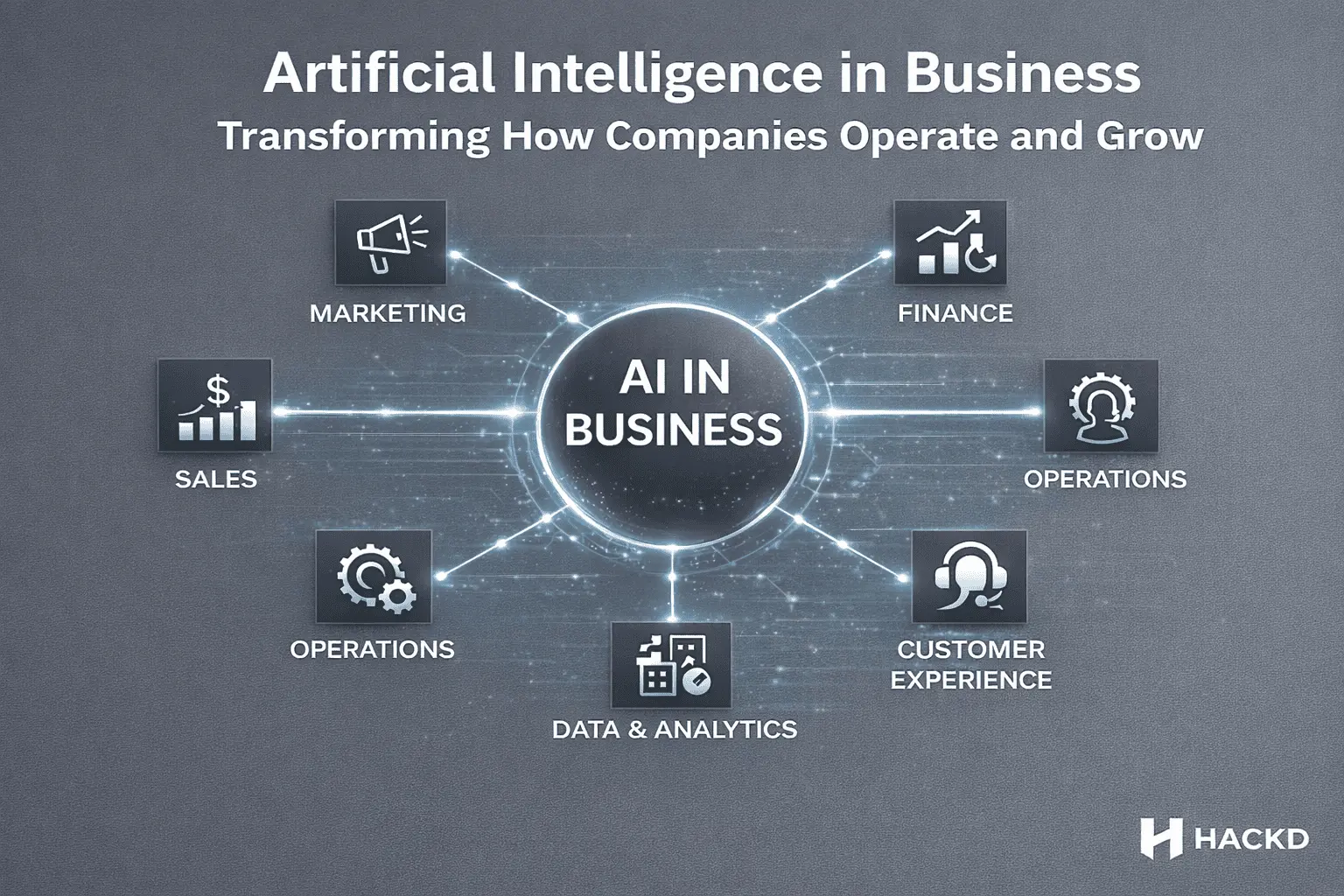
Today, artificial intelligence is used across marketing, sales, finance, operations, and customer service. As adoption continues to grow, it is becoming a key driver of innovation, helping businesses scale efficiently, reduce costs, and make smarter strategic decisions in competitive markets.
Why Artificial Intelligence Matters for Modern Businesses
As competition intensifies, businesses need smarter systems to stay efficient and scalable. When aligned with marketing and advertising, AI drives measurable growth. Here is why it matters:
- Data-Driven Decision Making: AI processes large datasets quickly, turning complex information into clear insights. This helps businesses make faster, more accurate decisions based on real data rather than assumptions or outdated reports.
- Operational Efficiency: Automating repetitive tasks allows teams to focus on strategic work. AI improves speed, reduces human error, and ensures consistent performance across operations, helping businesses run more smoothly and productively every day.
- Enhanced Customer Experience: AI analyses customer behaviour to deliver personalised interactions. From tailored recommendations to faster support, it helps businesses meet expectations, improve satisfaction, and build stronger relationships that drive long-term loyalty.
- Cost Optimisation: By streamlining processes and improving resource allocation, AI reduces unnecessary costs. Businesses can operate leaner while maintaining high standards, making growth more sustainable and less dependent on increasing operational expenses.
- Competitive Advantage: Businesses adopting AI early can innovate faster and respond better to market changes. It enables smarter strategies, improved offerings, and stronger positioning, helping brands stay ahead in increasingly competitive industries.
How Artificial Intelligence Works in Business
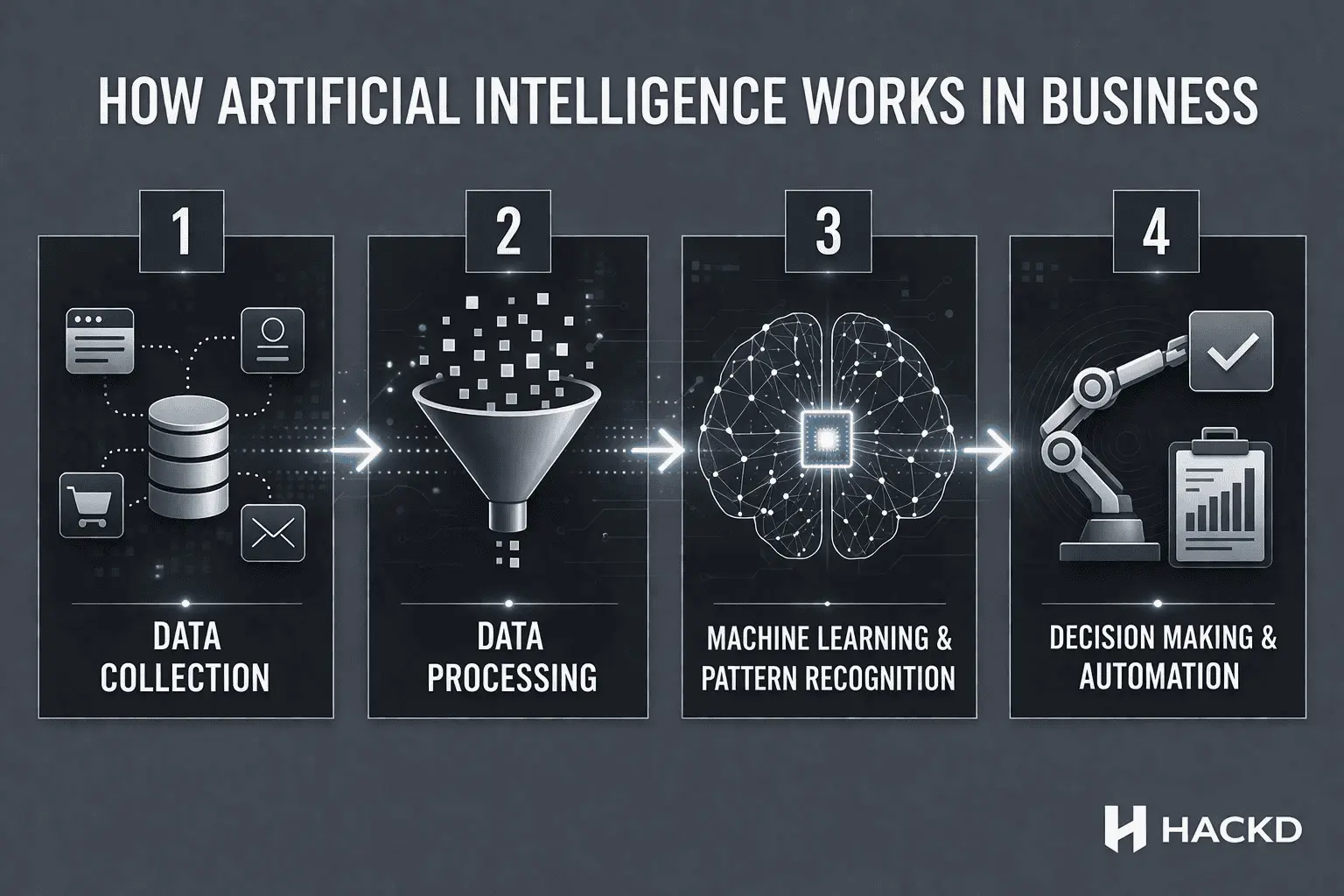
Understanding how AI operates in real business environments clarifies its value. Supported by web and app development infrastructure, systems integrate seamlessly and scale efficiently. Here are the key stages:
1. Data Collection from Multiple Sources
AI begins by gathering data from various sources such as websites, CRM systems, transactions, and customer interactions.
This includes both structured and unstructured data, forming the foundation for analysis. The quality and volume of this data directly influence how effective AI systems will be in delivering accurate insights.
2. Data Processing and Preparation
Once collected, data is cleaned, organised, and structured to remove errors and inconsistencies. This step ensures the information is usable and reliable for analysis.
Proper data preparation is critical, as poor-quality data can lead to inaccurate outputs and limit the effectiveness of AI-driven decisions.
3. Machine Learning and Pattern Recognition
AI models analyse processed data to identify patterns, trends, and relationships. Through machine learning, systems improve over time by learning from new data inputs.
This enables businesses to uncover insights, predict outcomes, and better understand customer behaviour or operational performance.
4. Decision-Making and Automation
Based on identified patterns, AI systems generate recommendations or take automated actions. This can include adjusting marketing campaigns, forecasting demand, or triggering workflows.
By reducing manual intervention, AI helps businesses respond faster and operate more efficiently at scale.
Core Technologies Behind Artificial Intelligence in Business
These are the core technologies powering artificial intelligence in business, helping organisations move from basic automation to smarter, data-driven decision-making systems.
- Machine Learning: Enables systems to learn from data and improve over time without manual programming, helping businesses predict trends, optimise processes, and make more accurate decisions based on patterns.
- Natural Language Processing (NLP): Allows machines to understand and interpret human language, powering chatbots, voice assistants, and sentiment analysis tools that improve customer interactions and communication efficiency.
- Computer Vision: Enables systems to analyse and interpret visual data such as images and videos, supporting applications like quality control, facial recognition, and automated inspection in various industries.
- Predictive Analytics: Uses historical data and statistical models to forecast future outcomes, helping businesses anticipate demand, reduce risks, and make proactive decisions that support growth and efficiency.
- Robotic Process Automation (RPA): Automates repetitive, rule-based tasks such as data entry and reporting, allowing businesses to reduce manual workload, minimise errors, and improve operational efficiency across departments.
Key Benefits of Artificial Intelligence in Business
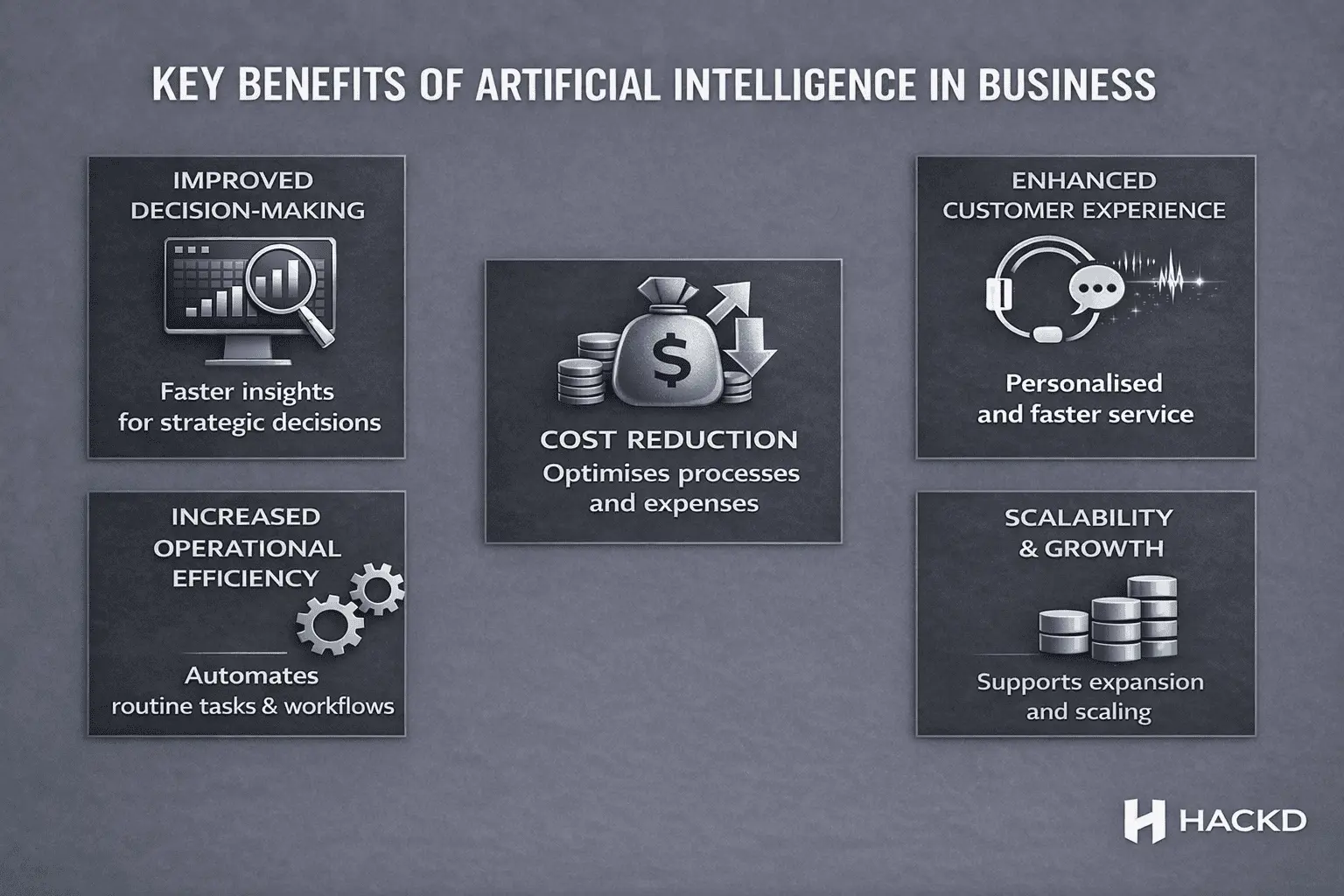
As businesses seek efficiency, growth, and smarter decisions, AI delivers measurable advantages across operations, strategy, and customer experience. Here are the key benefits driving adoption:
- Improved Decision-Making: AI analyses large datasets quickly, providing accurate insights that support strategic decisions. This reduces reliance on guesswork and helps businesses respond faster to trends, risks, and emerging opportunities.
- Increased Operational Efficiency: Automating routine tasks allows businesses to streamline workflows and reduce manual effort. AI improves speed, accuracy, and consistency, enabling teams to focus on higher-value work that drives growth.
- Enhanced Customer Experience: AI enables personalised interactions by analysing customer behaviour and preferences. Businesses can deliver relevant recommendations, faster responses, and tailored communication, improving satisfaction and building long-term loyalty.
- Cost Reduction: By optimising processes and resource allocation, AI helps businesses reduce operational costs. It minimises waste, improves efficiency, and allows organisations to scale without significantly increasing expenses.
- Scalability and Growth: AI supports business growth by handling increased workloads without compromising performance. It enables companies to expand operations, manage demand, and maintain quality while scaling efficiently in competitive markets.
How AI Is Transforming Different Industries
AI is reshaping industries by improving efficiency, accuracy, and decision-making across sectors. Here are key ways it is transforming major industries today:
1. Healthcare
AI is improving diagnostics, treatment planning, and patient care by analysing medical data faster and more accurately than traditional methods.
It supports early disease detection, personalised treatment recommendations, and operational efficiency in hospitals, helping healthcare providers deliver better outcomes while reducing costs and improving patient experiences across the entire care journey.
2. Retail and E-commerce
Retail businesses use AI to personalise shopping experiences, optimise pricing, and forecast demand more accurately. By analysing customer behaviour and purchase patterns.
AI helps brands deliver targeted recommendations, improve inventory management, and increase conversion rates, ultimately driving higher sales and stronger customer loyalty in competitive online and offline markets.
3. Manufacturing
AI enables predictive maintenance, quality control, and process automation within manufacturing environments. By monitoring equipment performance and detecting issues before they occur, businesses reduce downtime and improve productivity.
AI also enhances production efficiency by optimising workflows, ensuring consistent product quality, and supporting smarter resource management across manufacturing operations.
4. Finance and Banking
AI is widely used in fraud detection, risk assessment, and financial forecasting. It analyses transaction patterns to identify suspicious activity in real time, improving security.
Financial institutions also use AI to automate processes, enhance customer service, and provide data-driven insights that support smarter investment and lending decisions.
5. Logistics and Transportation
AI improves route optimisation, demand forecasting, and fleet management in logistics. By analysing real-time data, businesses can reduce delivery times, lower fuel costs, and improve operational efficiency.
AI also supports supply chain visibility, helping companies respond quickly to disruptions and maintain reliable delivery performance.
6. Real Estate and Construction
AI supports project planning, cost estimation, and risk management in construction and real estate. It analyses data to improve design efficiency, predict project outcomes, and optimise resource allocation.
This leads to better decision-making, reduced delays, and improved cost control across development and construction projects.
Challenges of Implementing Artificial Intelligence
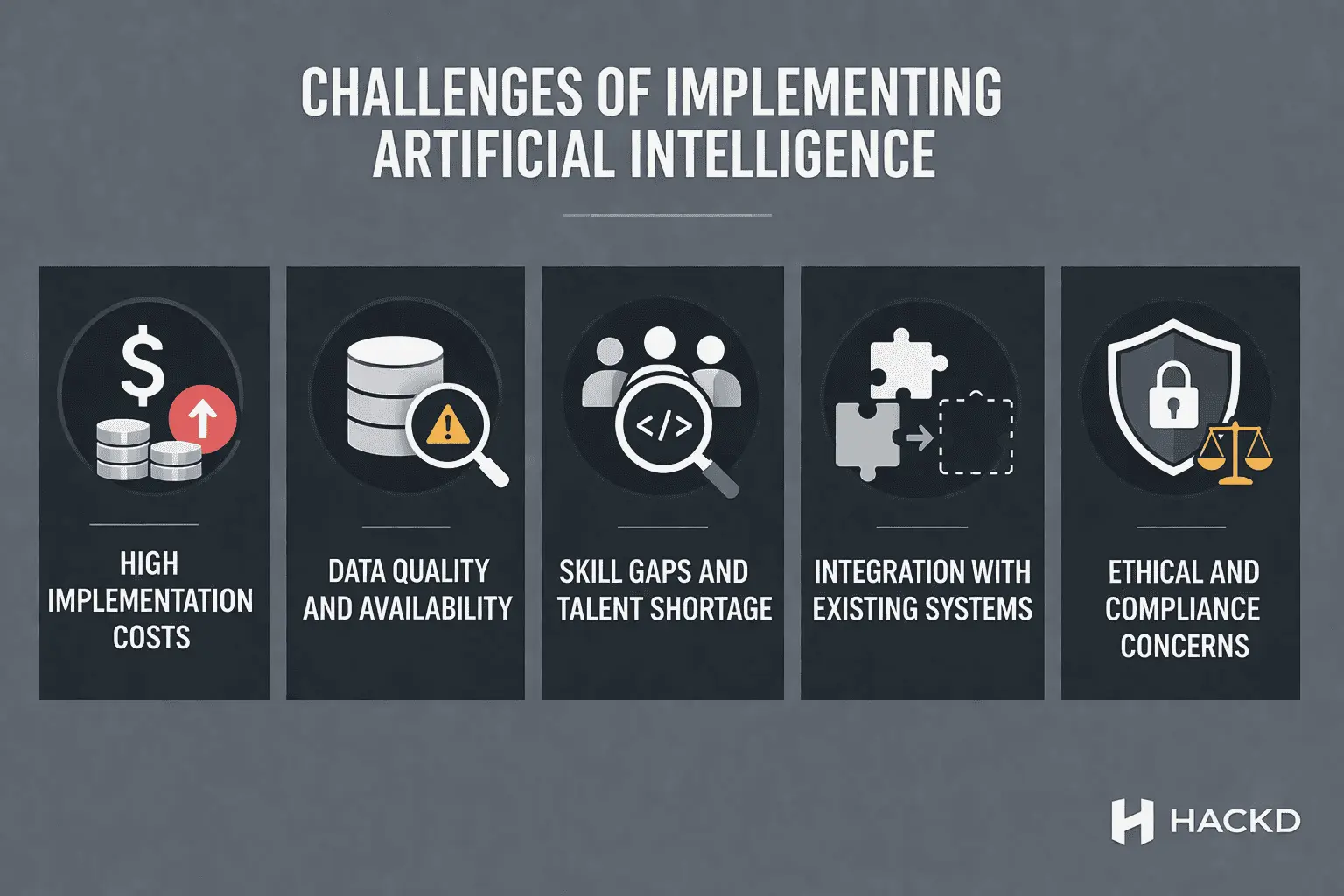
While AI offers strong advantages, adopting it comes with practical challenges that businesses must manage carefully. Here are the key barriers to successful AI implementation:
- High Implementation Costs: Developing and deploying AI systems can require significant investment in tools, infrastructure, and expertise. For many businesses, especially smaller ones, these upfront costs can slow adoption and limit experimentation.
- Data Quality and Availability: AI relies on large volumes of accurate, well-structured data. Poor data quality or limited access can reduce effectiveness, leading to unreliable insights and limiting the performance of AI-driven systems.
- Skill Gaps and Talent Shortage: Implementing AI requires specialised skills in data science, machine learning, and engineering. Many businesses struggle to find or retain this talent, making it difficult to build and manage effective AI solutions.
- Integration with Existing Systems: Integrating AI into legacy systems can be complex and time-consuming. Compatibility issues and outdated infrastructure can slow implementation, increase costs, and create operational disruptions during the transition process.
- Ethical and Compliance Concerns: AI raises concerns around data privacy, bias, and regulatory compliance. Businesses must ensure responsible use of AI, maintaining transparency and fairness while adhering to legal requirements and protecting customer trust.
How Businesses Can Start Using AI Effectively
Getting started with AI does not require complex systems from day one. Here are practical steps businesses can take to adopt AI effectively:
1. Identify Clear Business Problems
Start by defining specific challenges where AI can add value, such as improving customer support, automating repetitive tasks, or enhancing data analysis.
Clear objectives ensure AI is applied strategically, helping businesses avoid unnecessary complexity and focus on measurable outcomes that directly impact performance and growth.
2. Build a Strong Data Foundation
Ensure your business has access to clean, structured, and relevant data before implementing AI solutions. This may involve organising existing data systems, improving data collection processes, and ensuring accuracy.
Strong data foundations enable AI systems to deliver reliable insights and improve decision-making across operations.
3. Choose the Right Tools and Platforms
Select AI tools that align with your business size, goals, and technical capabilities. Many platforms offer scalable solutions for marketing, analytics, and automation.
Choosing the right technology ensures smoother implementation, reduces costs, and allows businesses to adopt AI without overwhelming internal teams or resources.
4. Start Small with Pilot Projects
Begin with small-scale AI projects to test effectiveness before full implementation. Pilot projects help businesses understand performance, identify challenges, and refine strategies.
This approach reduces risk, builds internal confidence, and creates a clear path for scaling AI solutions across the organisation.
5. Monitor, Learn, and Scale
Continuously track performance, analyse results, and refine AI systems based on insights. AI adoption is an ongoing process that improves over time.
Businesses that monitor outcomes and adapt strategies can scale AI effectively, ensuring long-term success and sustained competitive advantage.
The Future of Artificial Intelligence in Business
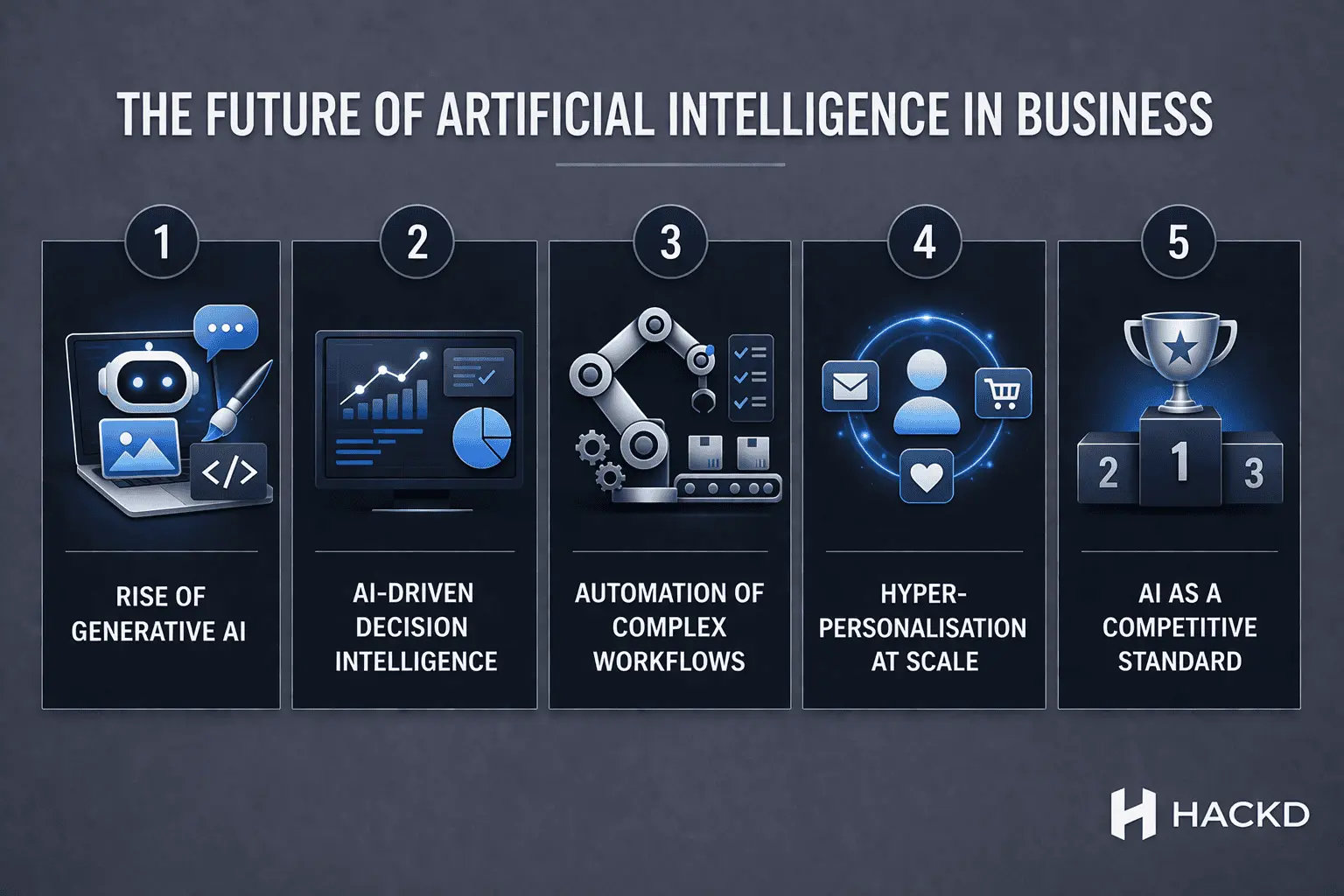
As technology advances rapidly, AI will play a deeper role in shaping how businesses operate, compete, and grow. Here are key trends defining the future of AI:
- Rise of Generative AI: Generative AI is enabling businesses to create content, designs, and code at scale. It enhances productivity across marketing, development, and operations, allowing teams to produce high-quality outputs faster while reducing reliance on manual processes.
- AI-Driven Decision Intelligence: AI will increasingly support real-time decision-making by analysing data continuously. Businesses will rely on predictive and prescriptive insights to guide strategies, improving accuracy, reducing risks, and enabling faster responses to changing market conditions.
- Automation of Complex Workflows: AI will move beyond simple automation to handle more complex, multi-step processes. This includes managing operations, coordinating systems, and optimising workflows, helping businesses operate more efficiently with minimal manual intervention.
- Hyper-Personalisation at Scale: AI will enable highly personalised customer experiences across channels. By analysing behaviour and preferences in real time, businesses can deliver tailored messaging, offers, and interactions that improve engagement and drive stronger customer loyalty.
- AI as a Competitive Standard: As adoption grows, AI will become a baseline capability rather than a competitive advantage. Businesses that fail to integrate AI effectively risk falling behind, while those that embrace it will remain relevant and competitive in evolving markets.
How Hackd Growth Helps Businesses Leverage AI
Hackd Growth helps businesses turn artificial intelligence from a concept into a practical growth driver. Rather than focusing on theory, the team works closely with businesses to identify where AI can deliver measurable impact, whether in marketing performance, data analysis, or operational efficiency.
This ensures every implementation aligns with real business objectives and delivers clear returns.
By combining AI with growth strategy, Hackd Growth integrates intelligent systems into existing workflows without unnecessary complexity.
From automating customer journeys to improving decision-making through data insights, the approach is designed to enhance performance across key areas of the business while keeping execution practical and scalable.
Most importantly, Hackd Growth focuses on outcomes. Every AI solution is built to improve efficiency, increase conversions, and support long-term growth. Businesses gain not just access to AI tools, but a structured strategy that turns intelligence into consistent, scalable results.
Turn Intelligence Into Growth
Artificial intelligence is no longer optional for businesses aiming to stay competitive. It is shaping how decisions are made, how operations run, and how customers experience brands across every industry. Those who adopt it strategically are building stronger, more scalable growth foundations.
As AI continues to evolve, its role will only deepen across marketing, operations, and data-driven strategy. Businesses that act early position themselves ahead of competitors, while those that delay risk falling behind in efficiency and innovation.
Partner with Hackd Growth to implement AI strategies that drive real results and scale your business with confidence.
Frequently Asked Questions
1. What is artificial intelligence in business?
Artificial intelligence in business refers to the use of advanced technologies that analyse data, automate processes, and support decision-making. It enables companies to operate more efficiently, reduce manual work, and gain insights that improve performance across marketing, operations, and customer experience.
2. How is AI used in businesses today?
Businesses use AI for tasks such as customer service chatbots, predictive analytics, personalised marketing, fraud detection, and process automation. It helps organisations streamline workflows, improve accuracy, and deliver better experiences by using data to guide actions and decisions.
3. What industries benefit most from artificial intelligence?
Industries such as healthcare, finance, retail, manufacturing, and logistics benefit significantly from AI. It improves diagnostics, enhances customer personalisation, optimises supply chains, and supports smarter financial decision-making, making it valuable across both service and product-based sectors.
4. Is artificial intelligence expensive to implement?
The cost of AI implementation varies depending on the complexity and scale of the solution. While some advanced systems require significant investment, many affordable tools and platforms now allow small and medium businesses to adopt AI without large upfront costs.
5. What is the difference between AI and automation?
Automation focuses on performing repetitive tasks based on set rules, while AI goes further by learning from data, identifying patterns, and making predictions. AI systems can adapt and improve over time, whereas traditional automation follows predefined instructions.
6. Can small businesses use artificial intelligence effectively?
Yes, small businesses can benefit from AI through accessible tools such as CRM automation, email marketing platforms, chatbots, and analytics software. These solutions help improve efficiency, reduce workload, and support growth without requiring large teams or resources.
.jpg.webp)